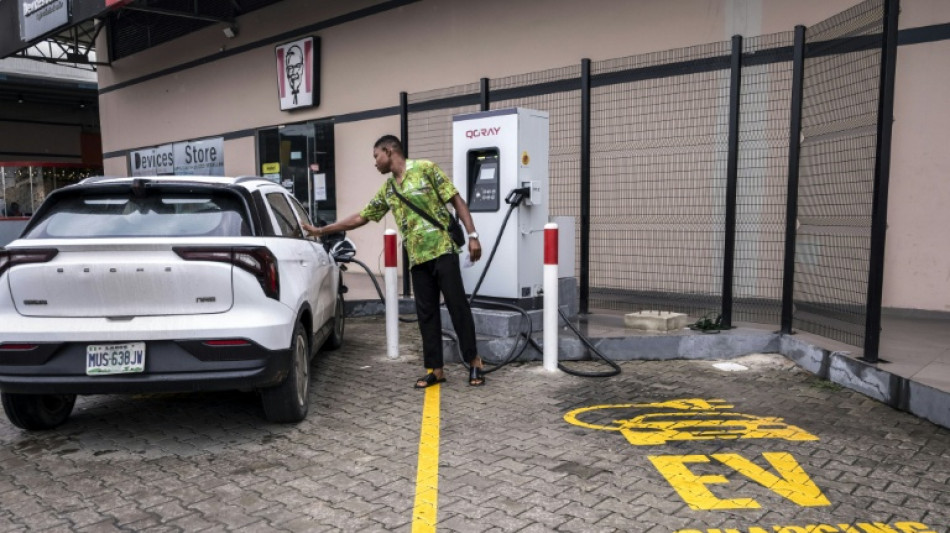
'There's no E': Blackout-plagued Nigeria pursues EVs / Photo: Temiloluwa Johnson - AFP

There are two ways to think about electric vehicles in Nigeria.
The first is that it's beyond folly to own an EV in a place where power outages are a fixture of daily life: the few EV drivers around are known to occasionally charge their vehicles off diesel-guzzling, black-smoke-puffing building generators that complement the nation's faltering grid.
The other is this: if it's possible to run an EV here, in a country where a vice president was once accused of being linked to a generator company that profited off the nation's grid collapse, then it's possible anywhere.
If EVs are coming for the world, this is the rough-and-tumble frontier.
"When it comes to the electricity supply in Nigeria, it's, I would say, location-based, because some sides (of town) have more light than others," said EV owner Khalifa Abubakar Alhassan, speaking diplomatically.
Some 90 million Nigerians -- a third of the nation -- don't have access to electricity at all, according to the World Bank. In May, a former energy minister was jailed for 75 years for money laundering linked to two failed hydropower projects.
But the government is pushing forward, aiming to make the country a hub for EV manufacturing while signing zero emissions pledges to slowly phase out new sales of autos with internal combustion engines.
For 22-year-old Alhassan, his neighbourhood in Abuja typically has "light", the Nigerian English term for grid power, consistently overnight -- perfect for charging his sleek, black sedan from China's Neta Auto.
"I enjoy not buying fuel," he added -- not a small expense in a country where pump prices have jumped some 650 percent since 2023, following the removal of a fuel subsidy, rampant inflation and shocks from the Iran war.
- In Nigeria, 'we adapt' -
According to the International Energy Association, more than one-in-five new cars sold worldwide in 2024 were electric, though almost all of that occurred in China, Europe and the United States.
But Mosope Olaosebikan, CEO of NEV Electric, a manufacturer specialising in buses and three-wheeled tuk-tuk or "kekes", is bullish on the sector's growth: the charging station he is building will be capable of charging 3,000 vehicles a day -- the largest on the continent, he reckons.
Challenges remain. Nigeria's GDP is the fourth largest in Africa, but after years of mismanagement and corruption, its grid is often shakier than that of neighbouring, poorer countries.
When Olaosebikan was starting his company four years ago, a nagging question was, "Oh, there's no 'E'. So where would they charge?" he told AFP.
But "one way or another Nigerians are producing the electricity."
Olaosebikan's station will use solar and compressed natural gas to power its chargers, with the national grid as back-up.
"We adapt in this part of the world," said Florence Boboye, of Lagos-based EV manufacturer Saglev.
Even when a driver charges their vehicle via a diesel generator -- as one AFP reporter in Lagos recently saw a neighbour doing -- that's still cheaper, and possibly more efficient, than running a typical internal combustion vehicle, she noted -- even if it looks a bit unseemly.
- Infrastructure needed -
On the sidewalk outside a charging station in downtown Abuja, women shading themselves with umbrellas sell mangoes and peanuts steps away from a Tesla Cybertruck.
Even cheap Chinese models that analysts say could upend the global industry are far out of reach for the millions of Nigerians in the informal economy.
But low-earners are still benefiting, said Dauda Adamu, 44, a bus driver in northeastern Maiduguri, where the Borno state government has rolled out electric buses with fares as low as 50 naira (less than four US cents) in the face of rising petrol prices.
"When the vehicles arrived, the joy I felt even made me cry because I no longer have to deal with engine oil or anything stressful," he told AFP.
On the federal level, Nigeria has approved green-friendly levies on heavy-engine vehicles, including gas-guzzling SUVs and trucks, set to go into effect in July. EVs are exempt.
Muhammad Abdulahi, 34, doesn't worry about power outages -- his home is completely off-grid, running on solar.
The Abuja resident drives a hybrid, whose extended range is useful for visiting family in Kaduna, considering there aren't any charging stations along the 200-kilometre route.
He works in the renewable energy industry, but his main motivation for driving his hybrid is that it's cheaper -- something EV companies in Nigeria are capitalising on since the government removed fuel subsidies.
He's thought about buying a fully electric vehicle -- but until the country's infrastructure catches up, "I would keep it within the city".
K.Hashimoto--JT