Bangladesh puts AI in driving seat to tackle terrible traffic / Photo: Munir UZ ZAMAN - AFP

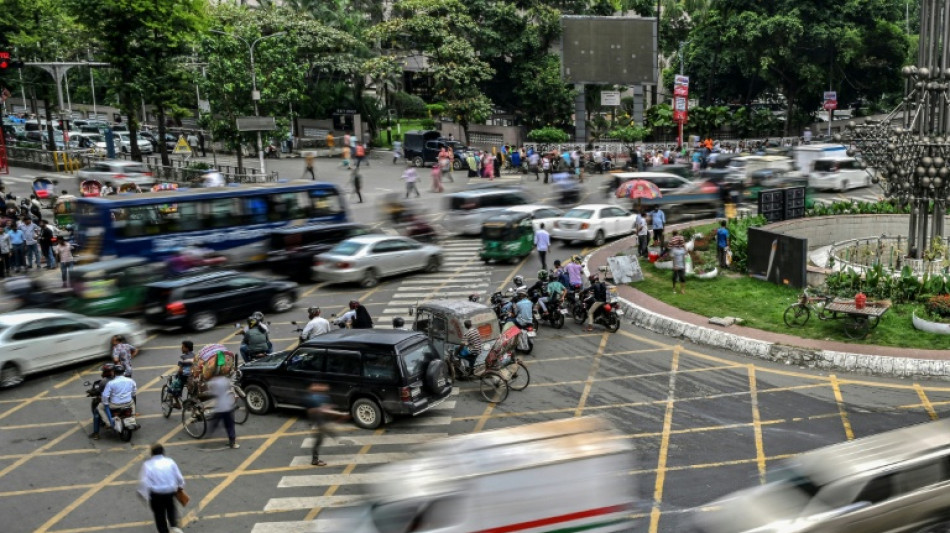
Bangladesh's densely populated capital, infamous for grinding gridlock, has launched its first AI-powered traffic enforcement system in a bid to bring order to one of the world's most congested cities.
Across Dhaka, buses, cars, motorcycles and pedal rickshaws jostle for space -- seeming to treat signals, pedestrian crossings and even traffic police as obstacles to overcome.
On-the-spot police fines often spark arguments, confrontations are common, and officers are sometimes struck by vehicles refusing to obey commands.
"Those who violate the rules turn against us," traffic sergeant SM Nazim Uddin told AFP.
"But since AI was introduced, people behind the wheel have started obeying the law -- and we have been spared the everyday quarrels."
Despite repeated attempts to modernise traffic management, the city of more than 22 million people had remained reliant on manual control, with officers stretching ropes across roads before traffic lights turned green.
But in April, Dhaka police linked traffic cameras to artificial intelligence software designed to automatically detect violations.
Motorist Hannan Rahman Jibon, 28, was among the first drivers caught.
"I ran a red light and the owner of my car, who was sitting at home, received a text message saying that the vehicle had violated traffic rules," said Jibon, who was hit with an automatic 2,000 taka ($16) fine.
"I am more careful now, with cameras installed in many different parts."
- 'Getting results' -
One study, by the US National Bureau of Economic Research, ranked Dhaka as the "slowest city" in the world.
With an average speed of just 4.8 kilometres (3 miles) per hour, according to a World Bank and Bangladesh University of Engineering and Technology study, it is quicker to walk.
City police spokesman N.M. Nasiruddin said the AI system used existing traffic-monitoring camera feeds -- with the software identifying offences ranging from signal and lane violations to illegal parking.
Coverage does not stretch across all the city, and manual traffic enforcement will be phased out over time, but police say it is changing behaviour.
"We have started getting results," Nasiruddin said. "We have prosecuted at least 300 vehicles."
Inside a control room at police headquarters, analyst Sharmin Afroze, 52, monitored a bank of live traffic feeds, plugged into the AI system, where violations it flags are checked by humans.
"Before, police used to stop vehicles, check papers and determine fines," Afroze told AFP, noting that in a single day, the system had recorded nearly 800 traffic violations.
For now, police are only fining the worst offenders -- while giving the others a warning.
- 'Do not follow rules' -
Still, officials admit the technology faces hurdles.
"We are facing some challenges too," Afroze said. "For example, some number plates are blurred or too small to identify."
Police are working with the road transport authority to address the issue, while additional features -- such as vehicles driving on footpaths -- will be added soon.
The system also currently targets motor vehicles, and police are still considering how to regulate Dhaka's vast fleet of pedal rickshaws, a defining feature of the city's traffic.
Hasib Mohammed Ahsan, a professor at Bangladesh University of Engineering and Technology, said the long-term success of the system would depend less on technology -- and more on whether authorities consistently enforce the rules.
"We have spent huge amounts of money on traffic signals and their upgrades, but those efforts were never sustained," Ahsan said.
"We do not follow rules, there is no consistency in our planning, and there is no accountability for failure."
Y.Watanabe--JT