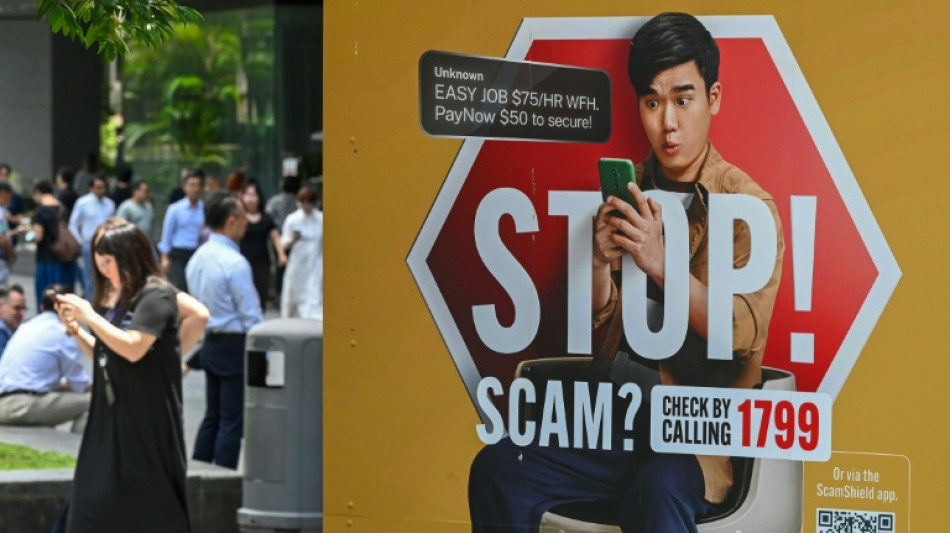
Singapore turns tide in evolving fight against scams / Photo: Roslan RAHMAN - AFP/File

Building his cryptocurrency holdings over eight years and helping out defrauded traders, Singaporean investor Mark Koh had thought he was savvy enough to spot a scam. Until he fell prey to one.
Fraudsters wiped out his entire portfolio last year -- a total loss of around US$120,000 or US$130,000, Koh estimates -- leaving him with a sense of "profound shame".
Singapore's high incomes, hyperconnectivity and public trust in institutions have long made it a prime target for scammers.
But the city-state is fighting back, including through tough laws that can compel tech giants to clamp down on fraud -- with scam cases and losses down last year for the first time since 2021.
Koh had years ago co-founded a non-profit supporting the victims of crypto scams.
But when he downloaded a beta test version of a game called "MetaToy" that turned out to be fake, it installed malware on his browser.
"I watched my wallets drain in real time," the 44-year-old told AFP.
"There's profound shame in being a victim -- especially when you've positioned yourself as someone who helps others avoid exactly this situation."
He posted online about his ordeal to raise the alarm about increasingly sophisticated online hoaxes.
It's a mission shared by Singapore's government, which has led its own scam education drive, including roadshows and talks with residents including migrant workers.
- Cane strokes -
Consumers worldwide lost US$442 billion to online fraud last year, the Global Anti-Scam Alliance estimates.
In Singapore, authorities say scams cost the population of six million people approximately US$1.6 billion for 2024 and 2025.
Even former prime minister Lee Hsien Loong has admitted to being duped into making an order on a fake e-commerce website.
But it appears the tide is turning.
Singapore's scam cases were down 28 percent to 37,308 last year from a record 51,501 in 2024, and losses also fell.
"The decrease... suggests cautiously that the anti-scam strategies and public education measures introduced by the government and industry partners have made it more challenging for scammers to succeed," police said.
Singapore has toughened punishments for convicted scammers -- including up to 24 strokes with a cane -- and created a 24-hour helpline that receives up to 700 calls daily.
Banks or police can now freeze accounts if they determine that a person is giving money to scammers, including falling for a fake job offer or a phishing attack.
And the city-state's 2023 Online Criminal Harms Act has strengthened the police's hand in ordering social media platforms to remove scam-related content or face penalties.
"Telegram, which had previously not responded to requests to disrupt criminal activity, has now acted on all directions issued to them," police said.
Yet criminals are finding new ways to exploit digital vulnerabilities, such as by using artificial intelligence to convincingly impersonate an individual.
- 'Playing catch-up' -
Scams have become a "mainstay" of modern crime and are "increasingly difficult to investigate because of their transnational nature", said Jeffery Chin, deputy director at the police Scam Public Education Office.
"We want to be ahead of the game, but because technology changes so fast, we sometimes find ourselves playing catch-up," he told AFP, adding that most perpetrators operate outside Singapore.
Impersonation scams soared 1,400 percent year-on-year in 2025 globally, according to Chainalysis, which also found that AI-enabled fraud was 4.5 times more profitable than its lower-tech equivalents.
Scammers usually reach targets in Singapore on social media -- 52 percent through Facebook, 26 percent through TikTok, and 14 percent through Instagram, authorities say.
Meta was last year ordered to step up safeguards on Facebook after scammers used images of top officials in impersonation schemes. A second directive in January required the company to extend monitoring to other high-profile users and implement enhanced facial recognition.
Meta said that in 2025 it had removed "more than 134 million scam ads" and helped arrests.
Apple and Google have been instructed to block spoofing of the "gov.sg" domain and other official names on their messaging platforms.
For Koh, who has found renewed purpose speaking at international conferences to warn users and investors, one thing is clear.
"The shame belongs to them (scammers), not you," he said.
Y.Kato--JT