Malaysian scientists recruit bed bugs as crime scene sleuths / Photo: Mohd RASFAN - AFP

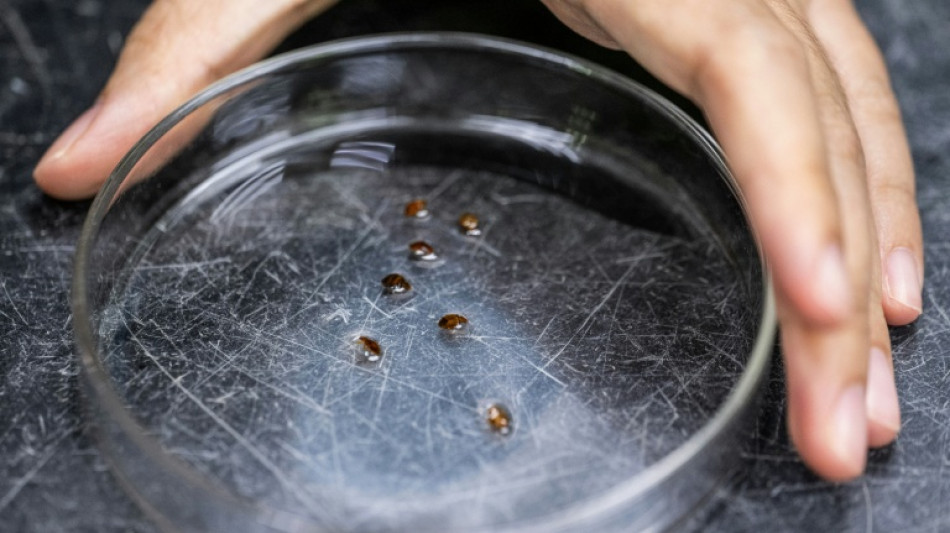
Under glaring laboratory lights, a research assistant extends his forearm and carefully inverts a mesh-topped container onto his skin to allow a wriggling mass of bed bugs to feed on his blood, all in the name of science.
Long-loathed as itchy household pests, the blood-sucking insects have revealed a darker, more intriguing potential as Malaysian scientists have discovered they can be turned into unlikely crime-busting allies.
A team from the Science University of Malaysia (USM) in northern Penang has found that tropical bed bugs can retain DNA from human prey for up to 45 days after snacking on an unwary victim.
This makes the tiny critters, who love to lurk in headboard cracks, mattress seams and pillow covers, ideal evidence resources when it comes to pinpointing suspects at crime scenes.
From a speck of blood, police investigators may one day be able to piece together the full profile of an offender, if the critters are present at a crime scene.
Analysing the insects could reveal gender, eye colour, hair and skin colour, entomologist Abdul Hafiz Ab Majid told AFP.
"We call bed bugs the 'musuh dalam selimut' (Malay for "the enemy in the blanket")," Hafiz said, adding that "they can also be spies" to help solve crimes.
- DNA profiling -
In a laboratory tucked deep inside USM's School of Biological Sciences, Hafiz and postdoctoral researcher Lim Li have spent nearly half a decade studying tropical bed bugs.
The bloodsuckers, scientific name Cimex hemipterus, are the most common species found in Malaysia and the tropics.
The bugs are reared in containers under a laboratory bench, each wrapped in black plastic to mimic conditions the insects thrive in.
"We place folded pieces of paper inside the small containers so the bed bugs have something to climb on," Hafiz said.
With the lab's temperature kept at a constant 23C to 24C, the insects suck up 1.5 to 5.3 microlitres of blood at each feeding, an "amount less than a droplet", Hafiz explained.
Researchers found DNA extracted from bed bugs that had fed on human blood could recover basic "phenotypic profiling", a person's observable traits, as well as gender for up to 45 days.
Using so-called STR (Short Tandem Repeat) and SNP (Single Nucleotide Polymorphism) markers, specific DNA sequences extracted from the blood, researchers can determine the gender, eye, hair and skin colour of potential suspects, long after they have fled the scene.
The USM study called "Human profiling from STR and SNP analysis of tropical bed bug, Cimex hemipterus", was published in Nature's Scientific Reports two years ago.
It was the first documented forensic use involving tropical bed bugs.
- 'Perfect' forensic tool -
Unlike mosquitoes and flies, bed bugs cannot fly, and once they have fed, "become engorged and can't move around that much", Hafiz said, adding that they can only move within 20 feet (six metres) of where they've fed.
"That's what makes them unique. We can say they are perfect to use as a forensic tool compared to mosquitoes that... fly away," Hafiz added.
The bugs are particularly useful at crime scenes, where fluids have been wiped away to destroy evidence, as the critters are often well-hidden.
Back in the lab, researcher Lim did not hesitate to demonstrate a feeding session, even joking that she had been a "willing victim" for science.
"I let them feed on my blood when I wanted to test how long (it would take) the human DNA to degrade," she said.
Lim insisted that the inconspicuous bugs are "misunderstood creatures" and do not spread diseases -- even though their bite leaves an itchy rash that can last for weeks.
"Maybe we can try educating people because the bed bugs are not actually vectors. So even if you get bitten, they can't transmit diseases to you," she said.
While the researchers imagined a future where tiny bed bugs at crime scenes could lead investigators to murder suspects, Hafiz said the insects weren't a magic fix.
Bed bugs have their limits -- especially when it comes to cracking cold cases, said Hafiz.
"It only gives investigators a time frame of 45 days to use bed bugs as evidence -- and only if they are available at the crime scene," he said.
K.Yoshida--JT