Bangladesh's liquor industry a surprising success / Photo: Rehman ASAD - AFP

Syrupy aromas drift across the guarded compound of Bangladesh's only licensed distillery, a state-owned producer posting record profits in the Muslim-majority nation, where Islamists are staging a political comeback.
That's a surprising success in a country where the vast majority of its 170 million people are barred from buying its products.
Alcohol is tightly regulated in Bangladesh, the world's fourth most populous Muslim nation.
Carew and Co, established under British rule 87 years ago, produced $10 million in profit in 2024–25, and paid the same again in taxes, said managing director Rabbik Hasan.
"This is the highest profit since the company's establishment," Hasan told AFP. "We expect further growth in the coming year."
Bangladesh has faced turbulent times.
A mass uprising in August 2024 ousted the autocratic government of Sheikh Hasina, who had been criticised for extensive human rights abuses and had taken a hard line against Islamist movements during her 15-year rule.
Since she fled to India -- defying extradition orders to attend her crimes against humanity trial -- Islamist groups have grown increasingly assertive.
Alcohol, forbidden under Islam, has escaped their condemnation, but they have demanded restrictions on cultural activities they consider "anti-Islamic" -- including music and theatre festivals, women's football matches, and kite-flying celebrations.
An interim government is leading the South Asian nation towards elections expected in February 2026.
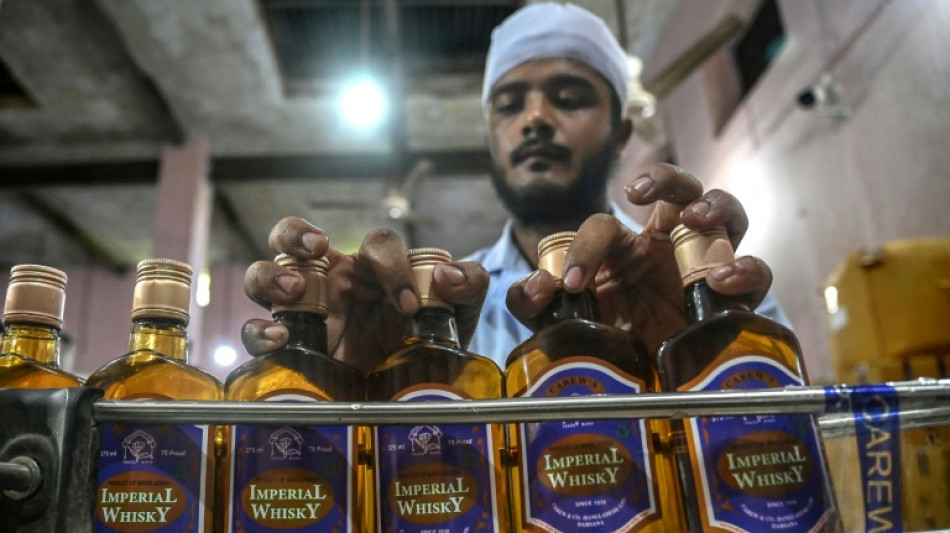
But at the sprawling Darsana facility near the Indian border, humming machines fill bottles.
Carew's popular brands range from the golden-hued "Imperial Whisky" to "Tsarina Vodka", distilled from sugarcane with flavourings imported from the Netherlands.
"We never encourage anyone to drink -- we only sell to those who already do," Hassan added.
- 'Zero doubt' -
Buying an alcoholic drink in Bangladesh requires a government permit, issued only to those aged over 21, and mainly granted to non-Muslims, who require a medical prescription.
"Alcohol is forbidden," said Hasan Maruf, director general of the Department of Narcotics Control, but added that "exemptions exist for certain communities".
That includes foreigners and workers on the country's tea estates, where Carew's low-cost liquor is popular among the 150,000 mainly Hindu workers.
Around 10 percent of Bangladeshi are not Muslims, mainly Hindus.
This year, only the company's sugar division suffered losses -- with its mills also producing fertiliser, vinegar, and industrial alcohol.
Carew provides the only source of regulated liquor -- alongside a separate brewery producing Hunter, Bangladesh's only beer, owned by the Jamuna Group conglomerate.
Those are reliable products in a country where illegal moonshine stills -- or the dangerous adulteration of imported liquor -- has been a persistent problem.
Fish trader Prince Mamun, 42, said he has been drinking Carew for two decades.
"It's cheaper and safer than imported brands," he said, adding that he holds a permit and drinks about 20 days a month.
"I drink Carew products with zero doubt."
Shah Alam, a devout Muslim and 38-year employee in the bottling unit, has never tasted the products.
Yet he praises the distillery for its contributions to the local community, from education to employment.
"I don't drink anything from here, nor am I involved with the selling," Alam, 59, said. "All I am doing here is my job."
S.Yamada--JT