ICJ climate ruling: five things to watch for / Photo: Lex van Lieshout - ANP/AFP

The International Court of Justice is preparing to hand down its first-ever opinion on climate change, seen by many as a historic moment in international law.
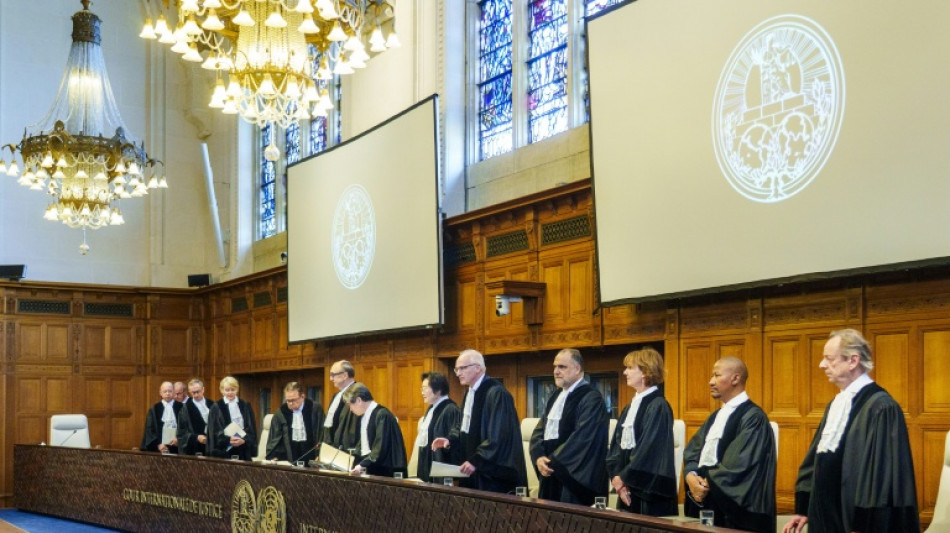
Judges have waded through tens of thousands of pages of written submissions and heard two weeks of oral arguments during the ICJ's biggest-ever case.
Its own "advisory opinion" is expected to run to several hundred pages, as it clarifies nations' obligations to prevent climate change and the consequences for polluters that have failed to do so.
Here are some of the key things to watch for when the ICJ delivers its ruling at 1300 GMT on Wednesday:
- What legal framework? -
This is the crux of the matter and speaks to the first question put to the court on countries' responsibilities to tackle climate change.
ICJ judges will seek to pull together different strands of environmental law into one definitive international standard.
Top polluters say this is unnecessary, and that the legal provisions under the United Nations Framework Convention on Climate Change (UNFCCC) are sufficient.
But opponents argue the ICJ should adopt a broader yardstick, including human rights law and the laws of the sea.
Vanuatu urged judges to consider "the entire corpus of international law" in its opinion, arguing the ICJ was uniquely placed to do so.
The ICJ is "the only international jurisdiction with a general competence over all areas of international law, which allows it to provide such an answer," said Vanuatu.
- And the consequences? -
This is the more controversial second question the judges will consider: what are the legal repercussions -- if any -- for countries who significantly contribute to the climate crisis?
The United States, the world's biggest historical emitter of greenhouse gases, and other top polluters referred the court to the landmark 2015 Paris Agreement, which does not explicitly provide for direct compensation for past damage.
Issues around liability are highly sensitive in climate negotiations, but at UN talks in 2022 wealthy nations did agree to create a fund to help vulnerable countries deal with current impacts caused by past pollution.
Many top polluters also say it is impossible to assign blame to individual countries for a global phenomenon with unequal effects.
Those on the other side of the debate point to a basic principle of international law -- "ubi jus, ubi remedium" -- roughly speaking, where there's blame, there's a claim.
In legal jargon, this should result in cessation, non-repetition and reparation, argue the climate-vulnerable nations.
They want the ICJ to propose a stop to fossil fuel subsidies, a drastic reduction in emissions, and a formal commitment and timeline for decarbonisation.
They also demand monetary reparation, as well as increased support for adapting to the devastating future effects of climate change.
- Harm or no harm? -
Another key point is the issue of "transboundary" law, often known as the "no-harm" rule.
Put simply, this key tenet of international law means one state should not permit activities on its territory that could cause damage to another.
The question ICJ judges will have to consider is: does this apply to greenhouse gas emissions that have contributed to climate change?
Major polluters argue this law does not apply to climate change as there is no single, specific source that can be identified as damaging another state.
Others say that climate change should not be an exception.
Other major international judicial decisions in recent months have looked to increasing scientific precision in the link between human-caused climate change and severe impacts like extreme weather, nature loss and sea level rise.
- When did they know? -
A fundamental debating point in the oral hearings was: when did governments become aware greenhouse gas emissions were harming the planet?
The late 1980s, according to the United States. Switzerland said no one could have linked emissions to rising temperatures before scientific studies in that decade.
Rubbish, say climate-vulnerable countries, who point to research in developed nations as early as the 1960s.
This could have an impact on when potential reparations kick in.
- 'Future generations' -
The concept of "intergenerational equity" is another fundamental demand of the young climate justice campaigners who helped bring this case to the world's highest court.
"The impact of climate change is not bounded by time," argued Namibia, with the worst effects hitting people decades or maybe centuries later.
But developed countries counter that the rights of as-yet-unborn people have no force in international law.
"Human beings alive now cannot claim rights on behalf of future generations," argued Germany.
K.Nakajima--JT