The Japan Times - Ethiopia's vast lake being pumped dry

EUR -
AED 4.234305
AFN 73.206022
ALL 95.812234
AMD 436.184273
ANG 2.063925
AOA 1057.280409
ARS 1587.291241
AUD 1.667055
AWG 2.077953
AZN 1.961064
BAM 1.949927
BBD 2.330401
BDT 141.992303
BGN 1.970794
BHD 0.435312
BIF 3436.663292
BMD 1.152977
BND 1.479051
BOB 7.994884
BRL 6.053341
BSD 1.157025
BTN 108.831715
BWP 15.767643
BYN 3.429201
BYR 22598.351259
BZD 2.327111
CAD 1.595536
CDF 2628.787676
CHF 0.914658
CLF 0.026844
CLP 1059.885276
CNY 7.957269
CNH 7.976186
COP 4267.571808
CRC 537.981872
CUC 1.152977
CUP 30.553893
CVE 109.933392
CZK 24.476208
DJF 206.042059
DKK 7.472157
DOP 69.760177
DZD 153.327594
EGP 60.872574
ERN 17.294657
ETB 180.6651
FJD 2.59218
FKP 0.862237
GBP 0.864946
GEL 3.10733
GGP 0.862237
GHS 12.649842
GIP 0.862237
GMD 84.749724
GNF 10141.496666
GTQ 8.855288
GYD 242.069809
HKD 9.020571
HNL 30.638845
HRK 7.536091
HTG 151.723649
HUF 388.485269
IDR 19502.607732
ILS 3.606368
IMP 0.862237
INR 108.477969
IQD 1515.840693
IRR 1514031.885631
ISK 142.66913
JEP 0.862237
JMD 182.251828
JOD 0.81743
JPY 184.046854
KES 149.766145
KGS 100.827377
KHR 4640.043795
KMF 492.321403
KPW 1037.746034
KRW 1737.415627
KWD 0.354517
KYD 0.9642
KZT 558.260877
LAK 24946.076013
LBP 103458.959416
LKR 363.897058
LRD 212.319549
LSL 19.490063
LTL 3.404441
LVL 0.697425
LYD 7.377873
MAD 10.783173
MDL 20.231237
MGA 4822.515874
MKD 61.638053
MMK 2421.233218
MNT 4132.071286
MOP 9.317276
MRU 46.101338
MUR 53.763579
MVR 17.813319
MWK 2006.373981
MXN 20.570881
MYR 4.605059
MZN 73.671727
NAD 19.489979
NGN 1597.611466
NIO 42.581923
NOK 11.111258
NPR 174.132249
NZD 1.995233
OMR 0.443302
PAB 1.157015
PEN 4.001066
PGK 4.998964
PHP 69.383888
PKR 322.936082
PLN 4.273193
PYG 7528.388952
QAR 4.219572
RON 5.097888
RSD 117.448046
RUB 95.007374
RWF 1689.51831
SAR 4.325551
SBD 9.272285
SCR 16.055447
SDG 692.939845
SEK 10.837521
SGD 1.481118
SHP 0.865031
SLE 28.305819
SLL 24177.365885
SOS 661.211226
SRD 43.052736
STD 23864.298223
STN 24.426531
SVC 10.124548
SYP 128.491078
SZL 19.500432
THB 37.926607
TJS 11.078682
TMT 4.03542
TND 3.395258
TOP 2.776092
TRY 51.153211
TTD 7.867337
TWD 36.827174
TZS 2963.219161
UAH 50.801122
UGX 4281.086328
USD 1.152977
UYU 46.838713
UZS 14111.555625
VES 532.779606
VND 30382.099695
VUV 137.231179
WST 3.170146
XAF 653.989946
XAG 0.017078
XAU 0.00026
XCD 3.115978
XCG 2.085328
XDR 0.813357
XOF 653.995601
XPF 119.331742
YER 275.157775
ZAR 19.696538
ZMK 10378.184071
ZMW 21.665928
ZWL 371.258157
  • RBGPF

    -13.5000

    69

    -19.57%

  • CMSC

    -0.1000

    22.81

    -0.44%

  • CMSD

    0.1800

    22.86

    +0.79%

  • RIO

    -1.7000

    85.84

    -1.98%

  • BCC

    0.4450

    75.095

    +0.59%

  • NGG

    -1.5700

    82.72

    -1.9%

  • BCE

    0.0700

    25.56

    +0.27%

  • GSK

    -0.1700

    54.53

    -0.31%

  • RELX

    -0.0750

    32.395

    -0.23%

  • RYCEF

    -0.6000

    15.3

    -3.92%

  • AZN

    -2.5200

    184.62

    -1.36%

  • BTI

    0.0550

    58.505

    +0.09%

  • VOD

    0.0250

    14.745

    +0.17%

  • BP

    0.8400

    46.25

    +1.82%

  • JRI

    0.0400

    12.14

    +0.33%

Ethiopia's vast lake being pumped dry
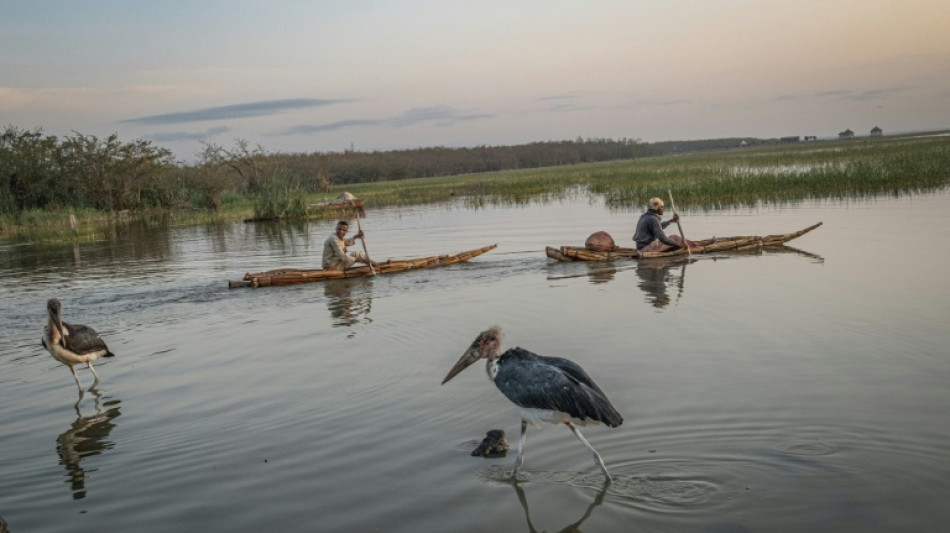
Ethiopia's vast lake being pumped dry / Photo: Marco Simoncelli - AFP

Ethiopia's vast lake being pumped dry

There is a constant hum around Ethiopia's enormous Lake Dembel -- the sound of its water steadily being sucked out by pumps.

Text size:

The pumps irrigate farms all around the lake, which is four times the size of Manhattan, and are vital for hundreds of thousands of people.

Ethiopia has already lost at least one large lake -- Haramaya, in the east of the country -- to over-pumping.

Now it risks losing another.

Lake Dembel's depth has halved since 1990 from four metres to two (13 feet to over six), according to Wetlands International, an NGO.

"If things continue like this, the lake could disappear," said its project manager Desalegn Regassa.

Pumping by farmers and industry is not the lake's only problem. Heavy pesticide use is also killing its fish, locals and the NGO say.

Belachew Derib has been fishing the lake since the 1980s but says stocks are disappearing.

"I built my house thanks to the income from fishing and support my three children through this work," Belachew, 60, told AFP as he rowed his small boat out to pull up his nets.

"Previously, we could catch 20 to 30 fish a day. Nowadays, young fishermen are lucky to catch two or three," he said.

Just a few dozen metres (yards) from the shore, AFP found Habib Bobasso, 35, liberally covering his small onion plot with pesticides from a pump strapped to his back.

"There are many worms that can damage the plants... we could lose the entire harvest," he said as he sprayed, with just a shawl to cover his face.

He knows the pesticides are harmful but sees no alternative.

"The fertilisers and pesticides we use degrade the soil. We spend too much money on fertilisers and chemicals for a low yield," he said.

- Degradation -

Water management is essential for Ethiopia, a land-locked giant in east Africa with a rapidly growing population already estimated at more than 130 million and often hit by droughts.

But a lack of funds and government oversight has allowed bad practices to continue for decades.

A recent report by the Stockholm International Water Institute blamed Ethiopia's "lacklustre policy frameworks" for "the demise of Lake Haramaya, the shrinking of Lake Abijata (and) the pollution of Awash River and Ziway and Hawassa Lakes."

Lately, the government has shown signs it is taking the problem seriously.

It passed a law earlier this year imposing a fee to extract water from Lake Dembel, which lies around 120 kilometres (75 miles) south of the capital Addis Ababa.

A local official, Andualem Gezahegne, told AFP he hoped this would curtail the pumps.

It cannot come too soon -- Wetlands International said there were some 6,000 pumps installed around the lake last year, running 24 hours a day, and "maybe more today".

AFP witnessed two huge tanker trucks filling up for a nearby highway project during a recent visit.

Keeping fishing under control is another challenge, said Andualem.

"Unfortunately, the peak fishing activity coincides with the fish spawning periods, from January to May," he said.

On the surface, the lake is still full of life -- from hippos to marabou storks.

But as the fishermen head out at dawn, the steady hum of the pumps strikes an ominous note for the future.

H.Nakamura--JT