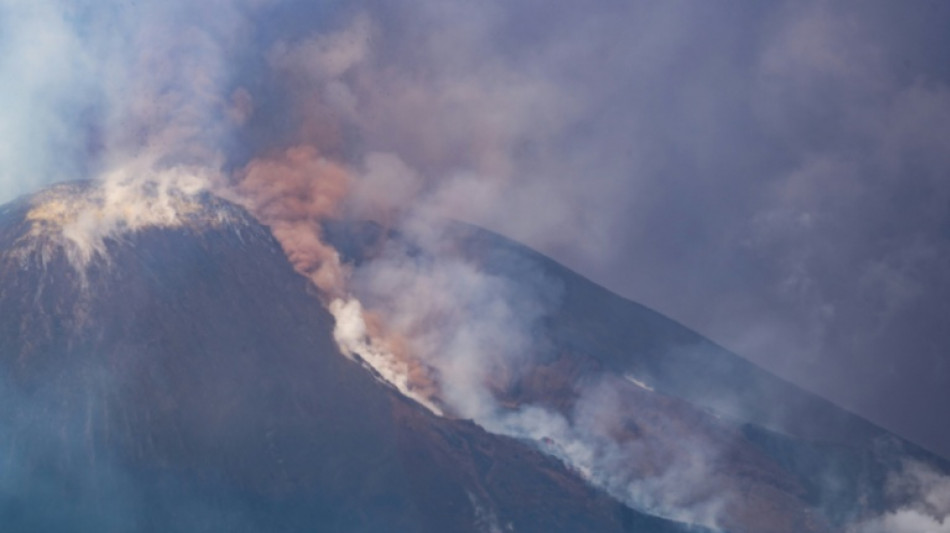
Italy's Mount Etna erupts, spewing ash, gas and rock / Photo: Giuseppe Distefano - AFP

A huge plume of ash, gas and rock spewed forth on Monday from Italy's Mount Etna as authorities warned people to steer clear of Europe's largest active volcano.
Sicily's Mount Etna has been active recently but Monday's eruption was the most dramatic, with experts warning that such activity could continue for weeks.
Images showed a massive grey cloud billowing from the volcano on the island of Sicily, beginning at 11:24 am local time (0924 GMT), according to the National Institute of Geophysics and Volcanology (INGV).
Surveillance cameras showed "a pyroclastic flow probably produced by a collapse of material from the northern flank of the Southeast Crater", the agency said.
A pyroclastic flow -- which is extremely dangerous -- occurs when volcanic rock, ash and hot gasses surge from volcanos.
The explosive activity "had transitioned to a lava fountain", INGV said, describing jets of lava being sprayed into the air.
By early afternoon, the plume had begun to dissipate.
An initial red alert that INGV issued for aviation authorities -- which estimated the height of the volcanic cloud at 6.5 kilometres (more than four miles) -- was downgraded to orange, then yellow.
Sicily's nearby Catania Airport remained open Monday.
By mid-afternoon, INGV said the eruption had stopped, with "no ash cloud produced".
The president of the region of Sicily, Renato Schifani, said experts had assured him there was "no danger for the population", with the flow not having passed the Valley of the Lion, an area frequented by tourists.
Videos posted on social media appeared to show tourists hurrying down the side of the volcano, some taking photos, but AFP could not determine their authenticity.
"The partial collapse of the Southeast Crater, which generated an impressive eruptive cloud several kilometres high and a pyroclastic flow, is a phenomenon that we follow with extreme caution," Schifani said.
The head of the regional civil protection unit, Salvo Cocina, recommended that tourists avoid the area.
- Persistent activity -
The intensity of the volcano seen on Monday "is one of the signs of the continuous dynamism of Etna", the president of the Italian Association of Volcanology, Marco Viccaro, told Corriere della Sera daily.
"The paroxysm that began last night and has continued to grow in intensity, falls within the dynamics of a volcano in persistent activity," he said, noting that Etna had been active for "several weeks".
That phase has been marked by "short-duration episodes, with intense energy" but less than those seen between 2020 and 2022, he said.
"This is strombolian activity that is relatively mild in the early stages and then rapidly intensifies until it produces explosions that are fairly energetic in frequency," he added.
The volcano was in a "recharge phase" in which magma, usually much deeper within the earth, was now closer to the surface.
How much of that magma had risen would determine how long the activity would continue, said Viccaro.
"The evolution depends on the volumes of magma that have entered the upper part of the feeding system," he said.
The activity, he added, "could evolve over weeks, if not months, with similar episodes to those we have witnessed."
K.Abe--JT