The Japan Times - Volcanoes 'hidden source' of CO2 in past climate change: study

EUR -
AED 4.095102
AFN 72.480008
ALL 90.801688
AMD 402.807486
ANG 1.995737
AOA 1023.635334
ARS 1721.721299
AUD 1.61933
AWG 2.007127
AZN 1.900047
BAM 1.955836
BBD 2.250342
BDT 139.162586
BGN 1.948955
BHD 0.422108
BIF 3342.96213
BMD 1.115071
BND 1.431727
BOB 13.402249
BRL 6.138357
BSD 1.117321
BTN 104.873949
BWP 15.391286
BYN 3.345962
BYR 21855.38619
BZD 2.247142
CAD 1.573644
CDF 2586.964483
CHF 0.914162
CLF 0.027822
CLP 1094.980351
CNY 7.444774
CNH 7.438418
COP 3608.76707
CRC 506.709417
CUC 1.115071
CUP 26.815498
CVE 110.267049
CZK 24.346956
DJF 198.963698
DKK 7.480457
DOP 67.891262
DZD 151.940824
EGP 59.957114
ERN 16.726061
ETB 183.378708
FJD 2.526309
FKP 0.833961
GBP 0.834166
GEL 2.893653
GGP 0.833961
GHS 13.055243
GIP 0.833961
GMD 83.077063
GNF 9896.183924
GTQ 8.538159
GYD 234.234353
HKD 8.744429
HNL 30.029558
HRK 7.547925
HTG 146.432722
HUF 363.51345
IDR 20192.258205
ILS 3.552538
IMP 0.833961
INR 104.716854
IQD 1693.83148
IRR 2108992.359359
ISK 136.919964
JEP 0.833961
JMD 177.323296
JOD 0.790629
JPY 176.710877
KES 145.192698
KGS 97.510486
KHR 4552.084602
KMF 492.86165
KPW 1003.563608
KRW 1520.737678
KWD 0.346765
KYD 0.931217
KZT 500.809308
LAK 25136.46717
LBP 100053.859534
LKR 371.556906
LRD 189.94353
LSL 18.477643
LTL 3.292514
LVL 0.674496
LYD 7.150133
MAD 10.921803
MDL 19.971371
MGA 5077.094359
MKD 61.556144
MMK 2341.311039
MNT 4015.078679
MOP 9.019368
MRU 45.108838
MUR 52.442198
MVR 17.176258
MWK 1937.436008
MXN 20.766565
MYR 4.528864
MZN 71.257178
NAD 18.477643
NGN 1502.23485
NIO 41.120764
NOK 10.548462
NPR 167.798119
NZD 2.015128
OMR 0.428348
PAB 1.117421
PEN 3.848972
PGK 5.092095
PHP 70.369926
PKR 309.016043
PLN 4.399568
PYG 6984.129802
QAR 4.084276
RON 5.343646
RSD 117.622186
RUB 91.352798
RWF 1649.13065
SAR 4.188587
SBD 8.974739
SCR 15.358485
SDG 670.719139
SEK 11.033072
SGD 1.430306
SHP 0.835103
SLE 25.591287
SLL 23382.48045
SOS 638.511867
SRD 41.908265
STD 23079.712667
STN 24.500455
SVC 9.776182
SYP 14498.149201
SZL 18.471343
THB 37.411034
TJS 10.307092
TMT 3.902748
TND 3.343362
TOP 2.684822
TRY 55.9111
TTD 7.577141
TWD 36.546782
TZS 2952.454872
UAH 50.616941
UGX 4570.084937
USD 1.115071
UYU 44.950835
UZS 13332.247784
VES 999.456181
VND 28526.296796
VUV 133.25575
WST 3.108617
XAF 655.957
XAG 0.021465
XAU 0.000274244363
XCD 3.013535
XCG 2.013637
XDR 0.788413
XOF 655.957
XPF 119.331742
YER 263.853652
ZAR 18.420333
ZMK 10036.978597
ZMW 22.703422
ZWL 359.052318
SSP 6406.644798
MXV 2.33632
  • RYCEF

    0.1000

    19.81

    +0.5%

  • VOD

    -0.2500

    16.33

    -1.53%

  • CMSC

    -0.2800

    20.12

    -1.39%

  • RBGPF

    -2.0000

    65

    -3.08%

  • RIO

    -0.2500

    94.16

    -0.27%

  • BTI

    -1.2000

    54.85

    -2.19%

  • NGG

    -0.3000

    74.94

    -0.4%

  • GSK

    -0.3500

    49.35

    -0.71%

  • BCE

    -0.4200

    20.14

    -2.09%

  • CMSD

    -0.3400

    19.93

    -1.71%

  • BP

    -0.9100

    43.52

    -2.09%

  • RELX

    0.1700

    33.24

    +0.51%

  • BCC

    -0.6200

    75.97

    -0.82%

  • AZN

    -1.9400

    164.21

    -1.18%

  • JRI

    0.0000

    10.77

    0%

Volcanoes 'hidden source' of CO2 in past climate change: study
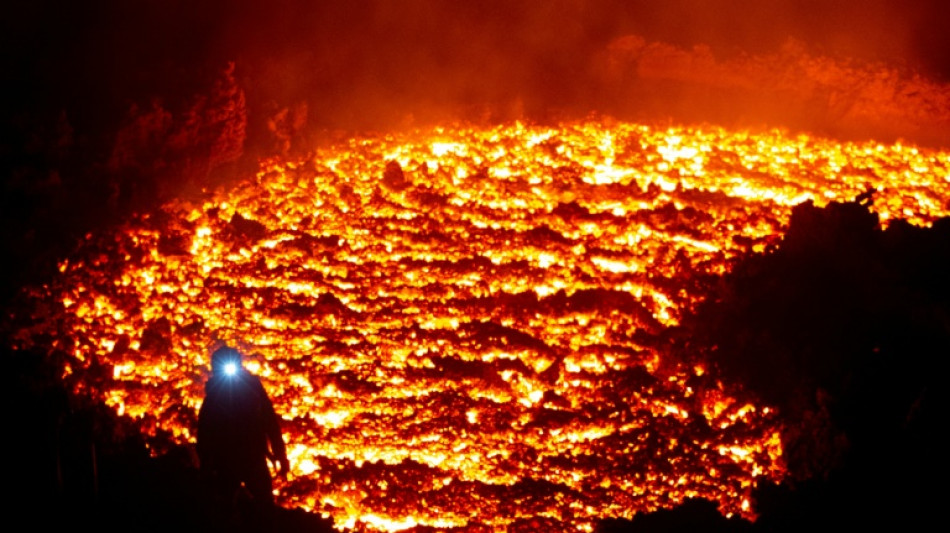
Volcanoes 'hidden source' of CO2 in past climate change: study / Photo: MAXIM FESYUNOV - AFP/File

Volcanoes 'hidden source' of CO2 in past climate change: study

Massive fields of magma underneath ancient volcanoes spewed out carbon dioxide long after eruptions on the surface had ended, potentially explaining why past global warming episodes lasted longer than expected, a study said Wednesday.

Text size:

Humans are emitting far more planet-heating carbon-dioxide (C02) than all the world's volcanoes put together. But scientists hope that by studying climate change in Earth's distant past, they can understand how the world heats up -- and crucially, how it can cool down again.

Scientists have long been puzzled by how long it took Earth's atmosphere to recover from a mass extinction event 252 million years ago that ended the Permian period.

It was the most severe extinction event in our planet's history, wiping out roughly 90 percent of marine species and 70 percent of those on land.

Scientists believe the upheaval was caused by huge volcanic eruptions in Siberia. The eruptions created what are called large igneous provinces -- huge underground regions of magma and rock -- which have been linked to four of the five big mass extinctions since complex life appeared on Earth.

It took Earth's climate nearly five million years to recover.

But according to scientific models, the world should have regrouped much more quickly.

"Earth's natural thermostat seems to have gone haywire during and after this event," said Benjamin Black, a researcher at Rutgers University in the United States and lead author of a new study in the journal Nature Geoscience.

- 'This gives me hope' -

To find out more, the US-led team carried out chemical analyses of lava, used computer models to simulate inner-Earth processes and compared climate records preserved in rock.

Their results suggested that even once volcanic activity had ended during past episodes, magma kept releasing carbon dioxide deep in the Earth's crust and mantle, which continued heating the globe.

"Our findings are important because they identify a hidden source of CO2 to the atmosphere during moments in Earth's past when climate has warmed abruptly and stayed warm much longer than we expected," Black said in a statement.

"We think we have figured out an important piece of the puzzle for how Earth's climate was disrupted, and perhaps just as importantly, how it recovered."

Black told AFP that the process described in the study "definitely cannot explain present-day climate change".

All the world's volcanoes currently "release less than one percent as much carbon to the atmosphere as human activities," he explained.

The type of volcanism the team investigated was last seen on Earth 16 million years ago, Black said, and was so enormous it could "cover the continental United States or Europe half a kilometre deep in lava".

But if the findings are confirmed, it could show that Earth's thermostat is working better than scientists had thought.

"This gives me hope that geologic processes will be able to gradually draw anthropogenic CO2 back out of the atmosphere," Black said.

"But it will still take hundreds of thousands to millions of years, which is obviously a long time for human beings."

Y.Watanabe--JT