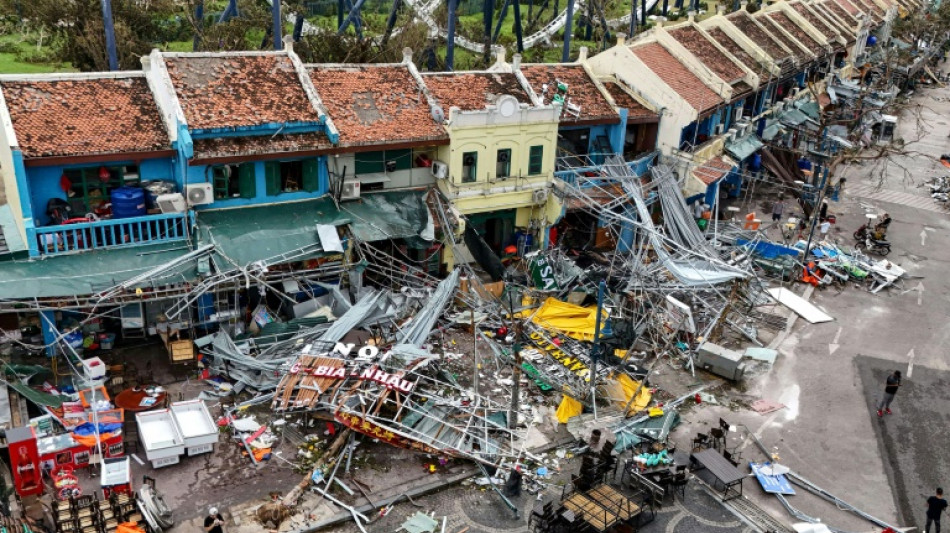
Local, foreign firms facing months of recovery in storm-hit Vietnam / Photo: NHAC NGUYEN - AFP

Factory roofs blown off, products worth millions of dollars destroyed, supply chains disrupted: Typhoon Yagi has had a disastrous impact on local and global companies in northern Vietnam who could take months to recover, business leaders warn.
The strongest typhoon to hit the country in decades slammed into the important industrial port city of Haiphong before unleashing a torrent of rain across the north, a major production hub for global tech firms such as Samsung and Foxconn.
With climate change making destructive storms like Yagi more likely, the disaster raises questions about Vietnam's push to become an alternative to China in the global supply chain owing to its high susceptibility and lack of mitigating measures.
Dozens of factories and warehouses in Haiphong were damaged by Yagi, while some in neighbouring Quang Ninh province expect to have no power until the end of the week, business leaders told AFP.
"I can guarantee that (the damage) is more than tens of millions of dollars," said Bruno Jaspaert, chief executive of DEEP C Industrial Zones, home to 178 companies across five industrial areas in Haiphong and Quang Ninh.
"At least 85 percent of our customers have sustained damage."
Many companies lost roofs, while another business saw 3,000 square metres (32,300 square foot) of wall panels blown off in gale-force winds, Jaspaert told AFP.
At the Haiphong DEEP C industrial zones, energy consumption was at two thirds of its usual rate, Jaspaert said, and was not expected to return to normal for another two or three months.
Hong Sun, chairman of the Korean Chamber of Business in Vietnam, told AFP the typhoon had been a "disaster" for his members, with some struggling with staff shortages as flooding stopped workers reaching factories.
Samsung -- Vietnam's largest foreign investor -- said its operations were running as normal, but a warehouse belonging to Korean giant LG Electronics was flooded last week, Hong said, damaging fridges and other home appliances.
LG told AFP it had resumed production of some products shortly after the storm and was making "every effort to swifty recover".
- 'China plus one' drive -
Among businesses from Japan, another major investor, around half reported some kind of damage -- while around 70 said their business had been interrupted or suspended, according to Susumu Yoshida at the Japan Chamber of Commerce and Industry.
Floods and landslides triggered by Yagi have killed more than 500 people across Southeast Asia -- 292 in Vietnam, according to government figures.
The southeast Asian nation of 100 million people has long been seen as a likely key beneficiary of the decoupling between the United States and the world's second-largest economy.
Investors have expanded into the country as part of a "China plus one" strategy and US President Joe Biden made a high-profile state visit to Hanoi a year ago.
Biden symbolically upgraded diplomatic ties and pushed Vietnam as a solid partner for "friendshoring" -- diversifying manufacturing supply chains away from China towards friendly countries.
Executives from tech behemoth Google, chip makers Intel and GlobalFoundries, and aviation giant Boeing joined Biden for investment talks in Hanoi.
But Vietnam is one of the world's most vulnerable countries to human-caused climate change, and without adaptation and mitigation measures, the World Bank estimates it will cost about 12 percent to 14.5 percent of GDP a year by 2050.
A study earlier this year said Southeast Asia -- and Haiphong specifically -- was facing "unprecedented threats" from longer and more intense typhoons because of climate change.
- 'Unprecedented threat' -
Vietnam's communist government has set a target to become a high-income country by 2045, but the World Bank says damage caused by climate change poses a "critical obstacle" to this goal.
Vietnam's government has already said Yagi caused an estimated $1.6 billion in economic losses, and would slow GDP growth in the second half of the year.
But if Vietnam's susceptibility is a worry for investors, most see a lack of climate-safe alternatives.
"Vulnerability due to climate change is subject to any region... (so) it will not affect Japanese investment," said Yoshida.
However, some hope the disaster may incentivise investors to consider renewable energies such as solar that could help shore up supply when storms or floods occur.
Solar and wind power grew tenfold to 13 percent of electricity generation from 2015 to 2023, on par with the global average and exceeding some Southeast Asian peers, according to Ember.
But Vietnam is still heavily reliant on coal, as well as hydropower which is vulnerable in heavy floods.
A shift "would depend on the existing policies for making more solar energy viable", according to Dinita Setyawati, senior electricity policy analyst for Southeast Asia at independent energy think tank Ember.
"These are the opportunities that the Vietnamese government should tap into."
S.Yamamoto--JT