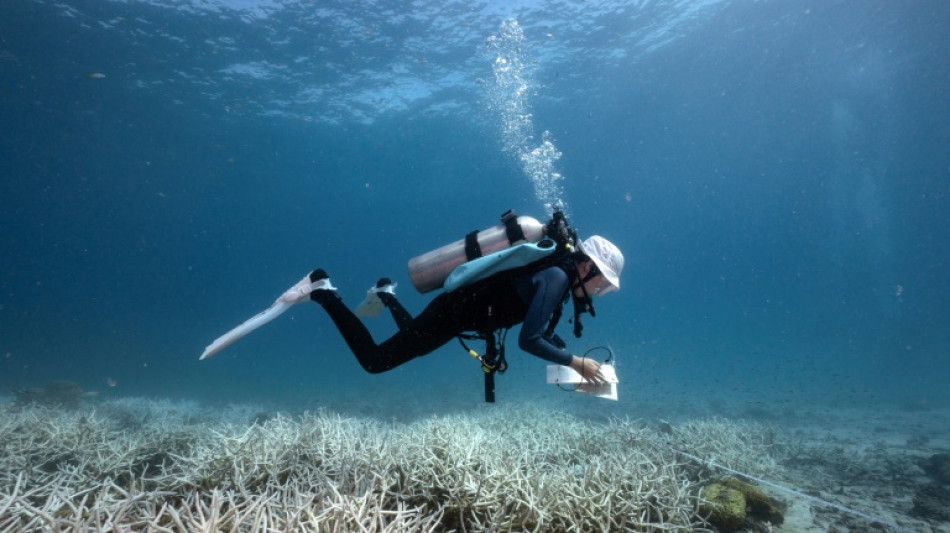
Divers turn conservationists as corals bleach worldwide / Photo: Lillian SUWANRUMPHA - AFP

A diver glides over an expanse of bone-white coral branches, recording the fish that dart between the ghostly arms extending from the sea floor off the Thai island of Koh Tao.
Nannalin Pornprasertsom is one of a growing number of scuba divers learning conservation and citizen science techniques as coral reefs experience a fourth global bleaching event.
After a two-week course in Koh Tao, the 14-year-old can identify coral types, carry out reef restoration, and help scientific research on coral health by recording the colour and tone of outcroppings at dive sites.
"It's just something that I can do that will have a good consequence for the environment," Nannalin, who has been diving since she was 12, told AFP after a series of dives.
"I want to help the reef."
And she is not alone.
The Professional Association of Diving Instructors -- better known as PADI, one of the world's leading dive training organisations -- says conservation certifications jumped over six percent globally from 2021-2023.
This year, it is launching a major shark and ray census, harnessing its network of divers to collect data that will shape protection policies.
On Koh Tao, Black Turtle Dive offers courses on everything from how to properly "dive against debris" -- collecting marine plastic or stranded fishing nets -- to coral restoration techniques.
"There's an increased awareness," said Steve Minks, a certified conservation instructor at Black Turtle.
"There's a lot of bleaching going on and there's a lot of concern about the marine environment."
- Death spiral -
Coral polyps are animals that depend on algae to provide most of their food. These algae also generally give the reef its colour.
But when the sea is too warm, the polyps expel the algae. The reef turns white and the coral begins to starve.
Coral bleaching has been recorded in more than 60 countries since early 2023, threatening reefs that are key to ocean biodiversity and support fishing and tourism globally.
The death spiral is everywhere in the waters of the Gulf of Thailand around Koh Tao.
Worst affected are branching species that grow quickly, but are also less resilient.
If water temperatures come down, they will have a chance at recovery. But for now, their spectral stems are even visible from the surface, glimmering through the aquamarine water.
"I was not ready for that much bleaching, it's quite an impact," admits instructor Sandra Rubio.
The 28-year-old says bleaching and other marine degradation are driving divers to take her conservation courses.
"People want to start learning because they see these kinds of changes," she told AFP.
"And even if they don't really understand why, they know it's not good."
She walks students through how to identify species, including soft coral. Wave at it, she explains, mimicking wiggling a hand in the water, and wait to see if it "waves back".
The skills taught at Black Turtle and other dive shops are not simply theoretical.
Artificial coral reefs are dotted around Koh Tao, actively rebuilding marine habitats.
And Nannalin's data on coral health is part of Coral Watch -- a global citizen science project that has produced numerous research papers.
"What we're doing is collecting data for scientists so they can actually work with governments and authorities," explained Minks.
- 'Doing our best' -
On a sunny afternoon on Koh Tao, a boat carries a starfish-shaped rebar structure designed by schoolchildren out to sea, where it will become Global Reef's latest coral restoration project.
Since it was founded two years ago, Global Reef has transplanted around 2,000 coral colonies, with a survival rate of about 75 percent, said Gavin Miller, the group's scientific programme director.
"It's not really going to maybe save coral reefs globally... but what it does do is have a very, very large impact locally," he said.
"We have snappers returning. We have resident puffer fish."
Global Reef also hosts interns who are training artificial intelligence programmes to identify fish in 360-degree videos for reef health surveys, and collaborates regularly with the dive school next door.
And they are studying the surprising resilience of some local coral to persistently high temperatures.
"These might be sort of refuges for coral," explained Miller.
This year's bleaching has left many marine enthusiasts despondent, but for conservation divers on Koh Tao, it is also a call to arms.
"In the previous generations, we didn't have this research and education that we have now," said Nannalin.
"I think people my age should make the most of it and try their best to reverse the things that have already been done."
The work also helps Rubio balance the sadness she feels at the changes below the water.
"It's not like we are going to change things from one day to another, but we are doing our best, and that is the best feeling," she said.
"I'm working every day to do something good for the environment and for the reef that I love."
K.Nakajima--JT