Peril and promise: gas from 'killer lake' powers Rwanda

The engineers aboard the floating power station on Lake Kivu could only watch nervously as the volcano in the distance erupted violently, sending tremors rumbling throughthe water beneath them.
It was notthe lava shooting from Mount Nyiragongo last May that spooked them, but the enormous concentrations of potentially explosive gases within Kivu, one of Africa's great Rift lakes lying between Rwanda and the Democratic Republic of Congo.
Flanked by rolling green hills tumbling into glassy waters, Kivu is not quite the picture of tranquility it seems, according to Francois Darchambeau from KivuWatt, a company that extracts gas from the lake's waters for electricity.
Thousands of years of volcanic activity has caused a massive accumulation of methane and carbon dioxide to dissolve in the depths of Kivu -- enough to prove monumentally destructive in the rare event they were released.
If triggered, a so-called limnic eruption would cause "a huge explosion of gas from deep waters to the surface" resulting in large waves and a poisonous gas cloud that would put the lives of millions at risk, said Darchambeau, environmental manager at KivuWatt.
"This is what we call a killer lake," the limnologist, or an expert in freshwater systems, told AFP.
Only three such lakes exist in the world: Kivu, and Lakes Nyos and Monoun in northwest Cameroon.
The latter two experienced limnic eruptions in the 1980s, and the bigger disaster at Nyos suffocated more than 1,700 people in a toxic release of carbon dioxide.
But these catastrophes occurred in a rural area, whereas some two million people would be "at risk" of such a similar disaster involving Kivu, said Darchambeau.
In both Rwanda and DR Congo, many live in fear of the lake's harmful potential, and stories abound of swimmers disappearing into its depths after being asphyxiated or pulled under.
- World first -
The lake, however, poses both peril and promise.
KivuWatt, which says this is the only project of its kind anywhere in the world, saw an opportunity to tap these abundant gases for energy generation.
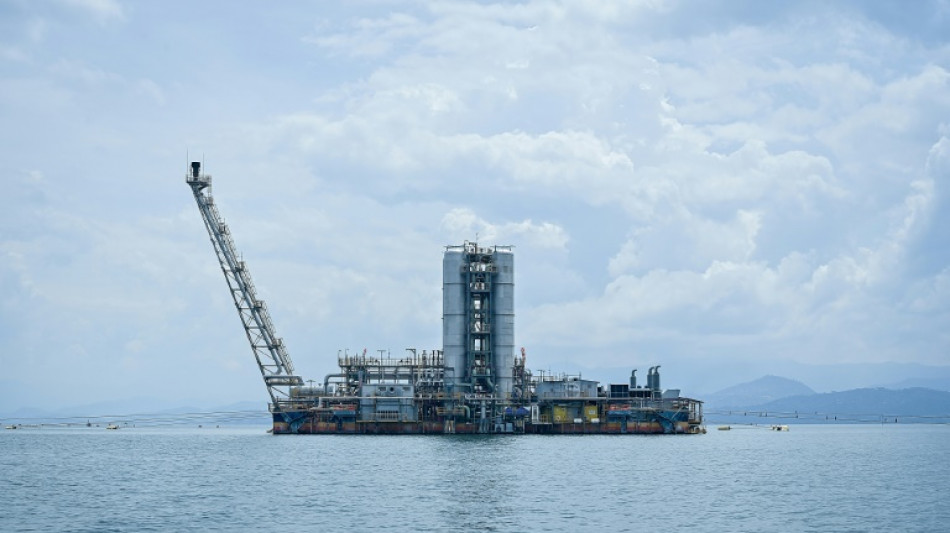
A 20-minute speedboat ride is required to reach KivuWatt's unique floating platform, a compact tangle of pipes and buoys as high as a multi-storey building moored in the Rwandan part of Kivu.
With a deafening roar, the facility pumps water saturated with carbon dioxide and methane from around 350 metres (1,150 feet) to the surface.
As it rises, the water and gas separate as the pressure changes.
"It is like opening a bottle of soda," said KivuWatt director Priysham Nundah, who described the project as "halfway between a thermal and a renewable energy plant".
The extracted methane is sent through a pipeline to a second facility located onshore in Rwanda, where the gas is transformed into electricity.
The carbon dioxide is pumped back into the lake at a precise enough depth to ensure the delicate balance is not upset.
The company says it hopes that removing methane could over time reduce pressure within the lake, possibly lowering the risk of a limnic eruption.
- 'It was frightening' -
But fears of such a disaster were reawakened when Nyiragongo -- an active volcano north of Kivu in DR Congo -- roared to life in early 2021.
The lava flow killed 32 people and destroyed hundreds of homes, as earthquakes shook the region. A second wave of lava pushed deep into the earth under the lake itself.
From their station, KivuWatt's engineers watched the sky turn red and angry.
"It was very frightening," said Nundah.
"When the rates of earthquakes and the frequency of earthquakes started to rise... no one could really say what would happen."
A shutdown was considered -- but the engineers held their nerve.
Suspending operations would have serious consequences for Rwanda: KivuWatt produces around 30 percent of the annual electricity consumed in the East African nation.
American company ContourGlobal, which owns KivuWatt, launched the Lake Kivu venture in 2015 and for a time considered expanding its capacity from 26 to 100 megawatts.
Another company is exploring the possibility of launching its own 56-megawatt gas extraction venture on the lake. There are no plans in the short term for such a project on the Congolese side.
How long it will take to deplete these vast gas reserves will depend on the pace of extraction, said Martin Schmid, a researcher at the Swiss Institute for Water and Environmental Research.
"Just with KivuWatt alone it will take, I don't know, centuries to have really a reduction of methane in the lake," he said.
K.Yoshida--JT