The Japan Times - Israeli women protest gender segregation on public transport

EUR -
AED 4.095102
AFN 72.480008
ALL 90.801688
AMD 402.807486
ANG 1.995737
AOA 1023.635334
ARS 1721.721299
AUD 1.61933
AWG 2.007127
AZN 1.900047
BAM 1.955836
BBD 2.250342
BDT 139.162586
BGN 1.948955
BHD 0.422108
BIF 3342.96213
BMD 1.115071
BND 1.431727
BOB 13.402249
BRL 6.138357
BSD 1.117321
BTN 104.873949
BWP 15.391286
BYN 3.345962
BYR 21855.38619
BZD 2.247142
CAD 1.573644
CDF 2586.964483
CHF 0.914162
CLF 0.027822
CLP 1094.980351
CNY 7.444774
CNH 7.438418
COP 3608.76707
CRC 506.709417
CUC 1.115071
CUP 26.815498
CVE 110.267049
CZK 24.346956
DJF 198.963698
DKK 7.480457
DOP 67.891262
DZD 151.940824
EGP 59.957114
ERN 16.726061
ETB 183.378708
FJD 2.526309
FKP 0.833961
GBP 0.834166
GEL 2.893653
GGP 0.833961
GHS 13.055243
GIP 0.833961
GMD 83.077063
GNF 9896.183924
GTQ 8.538159
GYD 234.234353
HKD 8.744429
HNL 30.029558
HRK 7.547925
HTG 146.432722
HUF 363.51345
IDR 20192.258205
ILS 3.552538
IMP 0.833961
INR 104.716854
IQD 1693.83148
IRR 2108992.359359
ISK 136.919964
JEP 0.833961
JMD 177.323296
JOD 0.790629
JPY 176.710877
KES 145.192698
KGS 97.510486
KHR 4552.084602
KMF 492.86165
KPW 1003.563608
KRW 1520.737678
KWD 0.346765
KYD 0.931217
KZT 500.809308
LAK 25136.46717
LBP 100053.859534
LKR 371.556906
LRD 189.94353
LSL 18.477643
LTL 3.292514
LVL 0.674496
LYD 7.150133
MAD 10.921803
MDL 19.971371
MGA 5077.094359
MKD 61.556144
MMK 2341.311039
MNT 4015.078679
MOP 9.019368
MRU 45.108838
MUR 52.442198
MVR 17.176258
MWK 1937.436008
MXN 20.766565
MYR 4.528864
MZN 71.257178
NAD 18.477643
NGN 1502.23485
NIO 41.120764
NOK 10.548462
NPR 167.798119
NZD 2.015128
OMR 0.428348
PAB 1.117421
PEN 3.848972
PGK 5.092095
PHP 70.369926
PKR 309.016043
PLN 4.399568
PYG 6984.129802
QAR 4.084276
RON 5.343646
RSD 117.622186
RUB 91.352798
RWF 1649.13065
SAR 4.188587
SBD 8.974739
SCR 15.358485
SDG 670.719139
SEK 11.033072
SGD 1.430306
SHP 0.835103
SLE 25.591287
SLL 23382.48045
SOS 638.511867
SRD 41.908265
STD 23079.712667
STN 24.500455
SVC 9.776182
SYP 14498.149201
SZL 18.471343
THB 37.411034
TJS 10.307092
TMT 3.902748
TND 3.343362
TOP 2.684822
TRY 55.9111
TTD 7.577141
TWD 36.546782
TZS 2952.454872
UAH 50.616941
UGX 4570.084937
USD 1.115071
UYU 44.950835
UZS 13332.247784
VES 999.456181
VND 28526.296796
VUV 133.25575
WST 3.108617
XAF 655.957
XAG 0.021465
XAU 0.000274244363
XCD 3.013535
XCG 2.013637
XDR 0.788413
XOF 655.957
XPF 119.331742
YER 263.853652
ZAR 18.420333
ZMK 10036.978597
ZMW 22.703422
ZWL 359.052318
SSP 6406.644798
MXV 2.33632
  • RYCEF

    0.1000

    19.81

    +0.5%

  • VOD

    -0.2500

    16.33

    -1.53%

  • CMSC

    -0.2800

    20.12

    -1.39%

  • RBGPF

    -2.0000

    65

    -3.08%

  • RIO

    -0.2500

    94.16

    -0.27%

  • BTI

    -1.2000

    54.85

    -2.19%

  • NGG

    -0.3000

    74.94

    -0.4%

  • GSK

    -0.3500

    49.35

    -0.71%

  • BCE

    -0.4200

    20.14

    -2.09%

  • CMSD

    -0.3400

    19.93

    -1.71%

  • BP

    -0.9100

    43.52

    -2.09%

  • RELX

    0.1700

    33.24

    +0.51%

  • BCC

    -0.6200

    75.97

    -0.82%

  • AZN

    -1.9400

    164.21

    -1.18%

  • JRI

    0.0000

    10.77

    0%

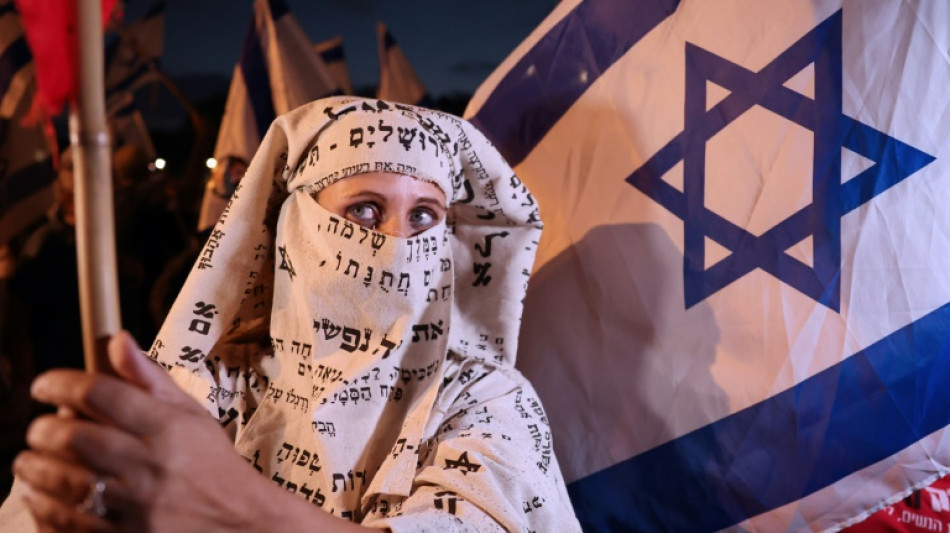
Israeli women protest gender segregation on public transport
Israeli women protest gender segregation on public transport / Photo: JACK GUEZ - AFP

Israeli women protest gender segregation on public transport

Hundreds of women holding Israeli flags protested on Thursday in an ultra-Orthodox Jewish suburb of Tel Aviv against what they said was rising gender-based segregation, especially on public transport.

Text size:

The protest in Bnei Brak came after media reports that several bus drivers in recent weeks had forced women to either sit in the back or simply refused to take them on board.

One report earlier this month said the driver of a public bus told a group of teenage girls to sit in the back and cover up after they boarded dressed in tank tops and jeans.

"There is no such thing called democracy without equality," the protesters chanted on Thursday, many holding placards that read: "We are equal."

"We can sit wherever we want, we can wear whatever we want... we are free and we are equal to every (other) citizen in Israel," said Kalanite Kain, 63, a writer who took part in the rally.

Many ultra-Orthodox Jewish residents of Bnei Brak looked on as the demonstrators passed by. Ultra-Orthodox Jews account for more than 10 percent of Israel's population.

The issue of gender segregation is not new in Israel where many observe religious practices that restrict mingling of the sexes.

But activists say that the discrimination against women has only been rising in recent years.

"Just because some religious groups, ultra-Orthodox religious groups think that women are the source of all evil ... doesn't mean that we should accept it," Hila Mor-Zenhavi, a lawyer, told AFP before the rally.

"My motivation for going (to the protest) is mainly my 10-year-old daughter. I want her to grow up in a world where she will have every opportunity, where she won't be excluded for being a woman."

Tel Aviv, the country's commercial hub, has also been the epicentre of protests against Prime Minister Benjamin Netanyahu's controversial plans to overhaul Israel's judiciary.

Since his government unveiled the reform package in January, tens of thousands of Israelis have joined mass demonstrations in what has turned out to be the biggest protest movement in the country's history -- one that has split the nation.

Opponents of the ambitious legislation see the overhaul as a threat to Israel's democracy.

Last month, the Israeli parliament voted on a key plank of the package that limits the so-called "reasonableness" law.

The new legislation curbs judicial review by Israel's top court of some government decisions, and critics fear it could pave the way to more authoritarian government.

The amendment of the clause is the first major component of the reform package to become law.

Other proposed changes include allowing the government a greater say in the appointment of judges.

Netanyahu's coalition government, which includes far-right and ultra-Orthodox Jewish parties, argues that the reforms are necessary to rebalance the relationship between elected officials and the judiciary.

H.Takahashi--JT