Canada wildfires slow allowing evacuees to return, but hot, dry weather coming / Photo: Anne-Sophie THILL - AFP

Cooler temperatures and light rain brought relief that allowed some wildfire evacuees to return home in Canada's Alberta province on Tuesday, but several blazes were still out of control and a coming sharp rise in the mercury could set back efforts to tame the fires.
Authorities have lifted evacuation orders for a handful of communities after beating back flames, but suffocating smoke still fills the air -- carried by winds across the continent as far as the Arctic and the US Atlantic coast.
The number of wildfires that forced 30,000 people to flee in the past four days has fallen from a peak of 110 to 81, with 24 still listed as out of control.
But officials warned that a return to hot and dry conditions was expected by Friday and would persist through the weekend.
Alberta Premier Danielle Smith noted that 30,000 hectares (74,000 acres) in the province are usually consumed by wildfires each year. "We've already had 390,000 hectares burned. So it's already 10 times the typical fire year and we're really just getting started," she told reporters.
"It's an extraordinary (and) unprecedented event, which is I think what we have to be prepared for in future."
"At the moment, it's all hands on deck," she said, noting that more than 700 firefighters are currently deployed and a request has been made for another 1,100 reinforcements from the rest of the country.
Fire chief for the county west of Edmonton, Brian Cornforth, said his crew of over 60 firefighters "are exhausted." "We've been at this for over a week and this fire keeps (spreading) to new areas."
He described how a grass fire in the area had spread across 90 kilometers (56 miles) "within a few hours."
"We need new resources and additional firefighters now," he told AFP.
"Over the next few days, we're gonna see it get drier and drier and hotter and hotter, and those two things work against us for firefighting."
- 'Seeing what can be salvaged' -
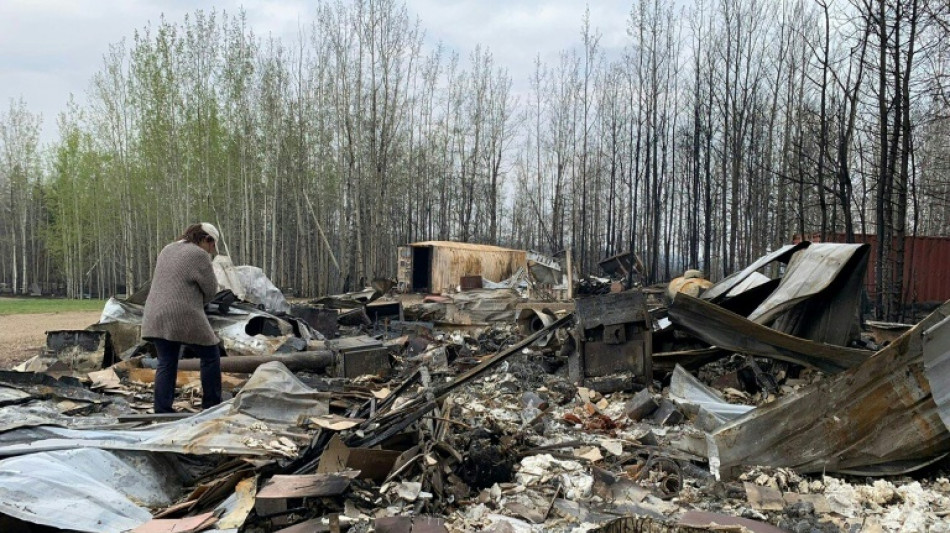
Around the town of Entwistle, 120 kilometers (75 miles) west of Edmonton, entire forests and grasslands were blackened and smoke billowed from the ground.
A local cemetary appeared to have been spared, but its tombstones were covered in soot and ash. Elsewhere, burnt-out trucks and collapsed buildings lined roads into the town, observed an AFP journalist.
Cheryl Harris, 58, returned to find a massive pile of charred debris in place of what was once a thriving river tubing business.
"We had a bunch of rain two days ago and that helped settle things, and we're getting a little bit of a sprinkle today, hopefully we'll get the rain that they're calling for, but we still need a lot (to douse) the wildfires," she said.
"Today it's cooled off enough that we can pick through and see what can be salvaged," she said.
Surveying the damage, Harris told AFP: "It's hard to see 16 years of work (destroyed)," pausing as she teared up. "But my husband, my kids and my pets are safe. That's more important than stuff."
Temperatures are forecast to rise up to 30 degrees Celsius (86 Fahrenheit) by Sunday.
"The short term is not looking all that great," warned Terri Lang, an Environment Canada meteorologist in Saskatoon, Saskatchewan.
"The long term forecast for May is not looking great either with above average temperatures and below average precipitation," he said.
"All that rain that's been falling over the last few days will quickly evaporate again once we get into these hot dry conditions (again)."
In recent years, western Canada has been hit repeatedly by extreme weather, the intensity and frequency of which have increased due to global warming.
Forest fires in Canada's oil sands region in 2016 disrupted production and forced out 100,000 residents from Fort McMurray, pummeling the nation's economy.
More recently in 2021, British Columbia suffered record-high temperatures over the summer that killed more than 500 people, as well as wildfires that destroyed an entire town.
That was followed by devastating floods and mudslides.
H.Nakamura--JT