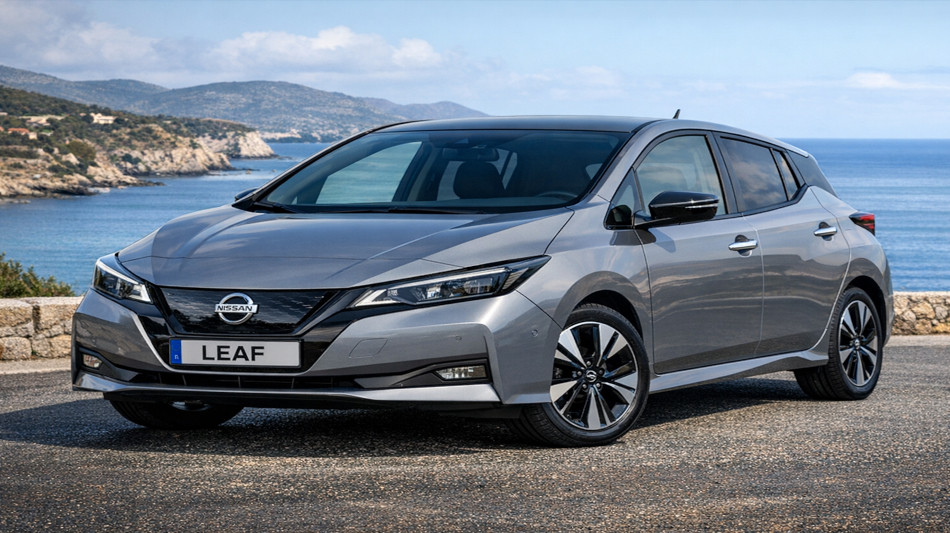
New Nissan Leaf 2026 review

The name ‘Leaf’ stands like no other for the early breakthrough of electric mobility in everyday life. Now Nissan is bringing back the Leaf as a completely repositioned model – not as a classic compact car as before, but as an aerodynamically designed electric crossover in a family-friendly size. The central promise: long range, modern assistance and infotainment technology, and an entry-level price that currently stands out in the German market. At the same time, the equipment list shows that the aggressive price has not been achieved without compromises – especially in terms of charging and the winter suitability of the basic version.
Pricing strategy: starting at £35,950 – and a clear focus on volume
Nissan is focusing on a clear spread for the new Leaf (model year 2026): the entry-level price starts at £35,950 (recommended retail price, typically plus delivery). The variants are priced up to £48,000.
Noteworthy: the smaller battery is only available in the basic version. Those who want more range and more comfort technology automatically end up with the larger battery and thus in a significantly higher price range. Although the Leaf is advertised at a ‘competitive price’, the configurations that are realistically in high demand (larger battery, more comfort) are in a price range where there is strong competition.
Two drive systems, two batteries – both front-wheel drive
Technically, Nissan is pursuing a two-pronged approach:
- Basic version: 130 kW (176 hp) on the front axle, coupled with a battery with a net capacity of 52.9 kWh
- Long-range version: 160 kW (217 hp) on the front axle, coupled with a net capacity of 75.1 kWh
Torque figures are 345 Nm (small battery) and 355 Nm (large battery). Acceleration to 100 km/h is stated as around 8.3 seconds (52 kWh version) and around 7.6 seconds (75 kWh version); the top speed is 160 km/h.
For many buyers, however, it is not so much the sprint time that is decisive as the consumption: here, the Leaf is extremely efficient. Depending on the version, 13.7 to 13.8 kWh/100 km (WLTP) are reported – a value that is remarkably low in this vehicle class.
- Range: up to 624 kilometres – but not in the basic version
- The range figures vary significantly depending on the battery:
- 52 kWh version: depending on the homologation status and equipment details, figures in the range of around 436 to 445 km (WLTP) are quoted
- 75 kWh version: up to 624 km (WLTP)
It is important to note the usual caveat: WLTP is a comparative standard. Temperature, speed, load, tyres and topography can significantly affect the actual results, especially in winter.
Charging: 11 kW AC – and this is where savings are made
The new Leaf comes standard with an 11 kW on-board charger (three-phase) for alternating current. A 22 kW option is not available. This may sound like a minor detail at first, but it is a real issue in everyday life – especially where many public AC charging points are designed for 22 kW or where users without their own wallbox are dependent on AC charging. An 11 kW vehicle only uses half of this infrastructure – and therefore takes longer to charge.
When it comes to fast charging (DC), Nissan clearly distinguishes between the versions:
- 52 kW variant: up to 105 kW DC
- 75 kWh variant: up to 150 kW DC
For both, the target is to achieve 20 to 80 per cent in under 30 minutes – but under the right conditions (charging power of the station, battery temperature, ambient temperature, preconditioning, etc.). This is precisely where another difference that is crucial for buyers comes into play.
Winter suitability: heat pump as standard – battery heating not
Positive: a heat pump for the interior is provided to reduce the energy required for everyday heating. This is an important efficiency detail for a family car with year-round ambitions.
The catch: active battery heating is linked to the large battery. For the 52 kWh base version, this means that although heating the interior remains more efficient than with pure resistance heating thanks to the heat pump, the battery temperature can become a bottleneck when fast charging in winter. If the battery is cold, it naturally accepts less power; without active battery heating, charging can be noticeably slower. This is a relevant point for long-distance drivers who want reliable fast charging even in frosty conditions.
Those who frequently drive in winter must therefore weigh up the pros and cons: the low entry-level price is attractive, but the winter fast-charging performance is likely to be more predictable, especially in the 75 kWh version.
Body and interior space: crossover format with a family focus
With a length of 4.35 metres, a width of 1.81 metres (without mirrors) and a height of 1.55 metres, the Leaf is clearly positioned in the compact crossover segment. The wheelbase of 2.69 metres promises decent space, even in the back seat.
Nissan quotes a boot capacity of 437 litres in normal mode and up to 1,052 litres with the rear seats folded down (depending on the measurement standard/loading scenario). Another interesting feature for families is that, depending on the equipment level, the Leaf is equipped with practical solutions such as a modular luggage compartment system and an optional electric tailgate.
The Leaf is also suitable for everyday use when it comes to trailers: up to 975 kg is specified for braked trailers (unbraked up to 750 kg). This means it cannot replace a large towing vehicle, but it is suitable for smaller trailers or leisure activities.
Equipment lines: four levels – and clear technology thresholds
Nissan offers the Leaf in Engage, Engage+, Advance and Evolve versions. The equipment is designed in such a way that certain technological highlights are only available in the higher lines.
Engage (base model, the only line also available with a 52 kWh battery):
Here, Nissan focuses on functional but modern basic equipment. This includes 18-inch alloy wheels, two 12.3-inch displays (infotainment and driver information), the 11-kW AC charger, vehicle-to-load capability (V2L, adapter required) and a wide range of assistance systems. Features such as keyless entry, dual-zone automatic climate control and smartphone integration are also included. Those who want heated seats and steering wheel in winter can add this via a winter package.
Engage+ (only with 75 kWh battery):
This level represents a major leap forward in infotainment: two 14-inch displays, NissanConnect with integrated Google functions, 15 W inductive smartphone charging and ProPILOT with Navi-Link. The latter aims to link the assistance functions more closely with navigation data, for example for more predictive adjustments to route planning.
Advance (only with 75 kWh battery):
Here, comfort takes centre stage: head-up display, dimmable panoramic glass roof, exterior design upgrades (including more distinctive light signatures), electric tailgate and enhanced comfort details such as heated steering wheel and heated front seats.
Evolve (top version, only with 75 kWh battery):
The top version focuses on premium elements: 19-inch wheels, a Bose audio system, electrically adjustable front seats including a massage function for the driver, and the Vehicle-to-Load adapter.
Infotainment and connectivity: Google ecosystem, OTA and remote access
A central part of the reorientation is the digital platform. From the higher lines upwards, infotainment with integrated Google functions is planned, including map navigation, voice assistance and app ecosystem. This is supplemented by over-the-air updates and app-based remote functions (e.g. charging planning, pre-conditioning, vehicle status). Also relevant for fast charging: battery preconditioning is communicated to improve charging performance, depending on conditions.
The Leaf 2026 in everyday use: strong on efficiency, but with clear target groups
The bottom line is that the new Nissan Leaf is a deliberately designed alternative to many ‘ever heavier, ever more powerful’ electric SUVs. The data focuses on efficiency, everyday usability and a comparatively low entry-level price. At the same time, those who charge a lot using public AC charging points will have to make do with 11 kW. And those who regularly rely on fast DC charging stops in winter should check very carefully whether the battery heater is included in the selected version.
It is precisely this combination that makes the Leaf 2026 so interesting: it is neither a pure economy model nor an uncompromising technology carrier – but a strategically calculated crossover that is particularly impressive in practice when the configuration, charging profile and area of application are all compatible.