Luce: Ferrari's ingenious electric revolution

Rome is set to be the scene of a milestone that could hardly be more significant for Ferrari: on 25 May 2026, the manufacturer plans to present its first fully electric production Ferrari to the public. The name of the model has already been decided – ‘Luce’, Italian for ‘light’. And it says it all: not as a departure from tradition, but as a deliberate starting point for a future in which performance, emotion and electrification come together. Ferrari is not just talking about a new type of drive system – but about a new chapter in the brand's identity.
Three phases until the world premiere – and a deliberately built-up suspense arc
Ferrari has designed the launch of the Luce not as a classic ‘curtain up’ moment, but as a multi-stage unveiling. After the early technical visualisation of key components, the next, strongly design-driven stage followed in early 2026: the name and interior were revealed in advance, without revealing the complete exterior. This dramaturgy is no coincidence. It signals that Ferrari does not want the Luce to be seen as merely an ‘electric model’, but rather as the start of a separate segment within its own model range – with its own character, its own design language and a clear message: electrification is not an end in itself here, but a tool for new possibilities.
What is certain so far: performance beyond the 1,000 hp mark – and everyday usability as the goal
Although Ferrari is traditionally cautious about final data, several key technical details are now known that clearly define the Luce's aspirations. It will have over 1,000 hp as its peak output (depending on the operating mode), combined with acceleration that is at home in the supercar segment: 0–100 km/h in around 2.5 seconds is considered a benchmark. Added to this is a WLTP range of around 530 kilometres – a figure that clearly shows that Ferrari is positioning the Luce not just as a short-range ‘show car’, but as a high-performance vehicle with serious travelling range.
A high-voltage architecture is designed to ensure charging performance: fast charging up to 350 kW is mentioned – a level that puts the Luce in the front row of modern performance electric cars. The focus is therefore not only on maximum values on the racetrack, but also on a point that is increasingly crucial for demanding customers: time. Those who travel long distances expect not only range, but also short charging windows – and this is precisely where Ferrari clearly wants to be on a par with the best.
Four electric motors, new driving dynamics logic – and Ferrari's trademark precision
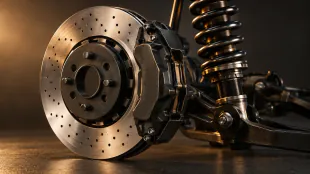
Technically, there are many indications that Ferrari is opting for a four-motor configuration for the Luce – i.e. one electric motor per wheel. This is much more than ‘four-wheel drive’ in the classic sense: it enables extremely fine torque distribution (torque vectoring), new stability strategies and driving dynamics that are no longer tied to mechanical couplings. In addition, modern systems such as rear-axle steering and a sophisticated chassis concept are mentioned, which should be able to control body movements very actively.
The goal behind this is clear: Ferrari wants to prevent ‘electric’ from feeling like weight and inertia. Instead, the Luce is intended to deliver what fans have associated with the name for decades: immediate response, razor-sharp precision and a balance that is convincing not only at high speeds, but right from the first steering angle.
The sound: Not a theatrical backdrop, but a ‘real’ signature
One of the most emotional topics surrounding electric sports cars is the sound. Ferrari has clearly taken a clear direction here: instead of artificial ‘combustion engine staging’, a system is to be used that utilises and amplifies real vibrations from the powertrain. The idea: the Luce should not pretend to have cylinders – it should be recognisable as an electric Ferrari, but still have an acoustic identity typical of the brand. This is a delicate balancing act, because sound is not decoration at Ferrari, but part of the driver's connection to the car. That is precisely why this solution seems like an attempt to put authenticity above effects.
An interior like a manifesto: Retro, tactile, deliberately bucking the touchscreen trend
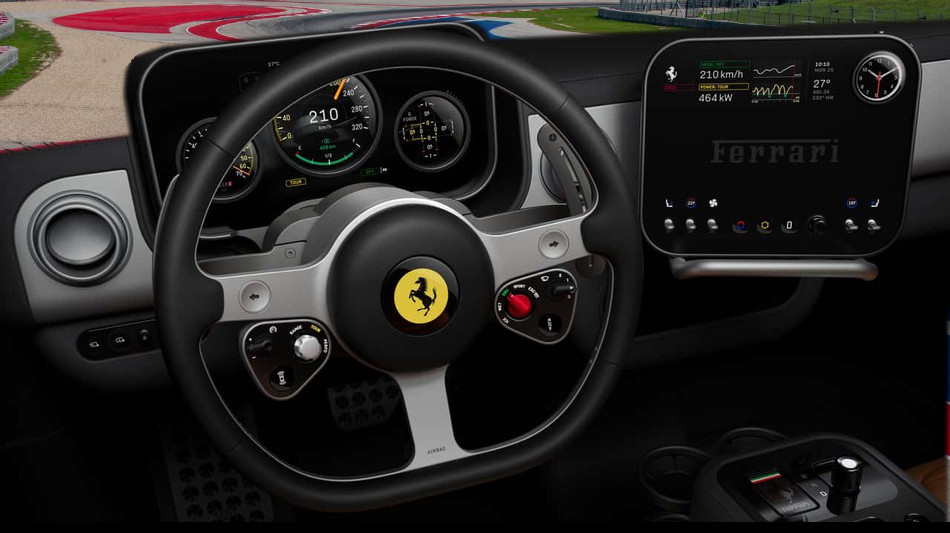
Even before the exterior is fully revealed, one thing is clear: the interior is a statement. Instead of huge screens, the design focuses on tactile controls – with classic buttons, switches and instruments that deliberately evoke mechanical logic. This ‘retro in high-tech guise’ is already polarising public opinion, but that is precisely what makes it so typical of Ferrari: not to everyone's taste – but clearly recognisable.
Central to this is the philosophy that a sports car does not have to function like a smartphone. Many functions should remain operable blindly, without having to navigate through nested menus. This is complemented by a digital display set-up that apparently does not primarily aim to be ‘bigger’, but rather clearer and more focused. The steering wheel also picks up on this theme: a three-spoke aesthetic that combines historical charm with modern ergonomics.
It is also interesting to note that the designer responsible is said to have publicly admitted to being ‘nervous’ about the scope of the project – a rare open signal of how much pressure there is to strike the right note here.
Design collaboration with LoveFrom: Maranello meets Silicon Valley – without losing Ferrari
Another very noteworthy point is the design partnership: The interior of the Luce was not developed exclusively within the classic Ferrari design universe, but in collaboration with LoveFrom, the creative collective led by Jony Ive and Marc Newson. Ferrari is thus deliberately bringing external perspectives on board – not to ‘alienate’ the brand, but to integrate new product logic: reduction, clarity, interaction design. At the same time, the Luce should remain clearly recognisable as a Ferrari. This is precisely where the challenge lies: minimalism without sterile arbitrariness; innovation without breaking with tradition.
Body and concept: Four-door, new proportions – and a segment that Ferrari has not yet had
Ferrari is keeping the suspense high when it comes to the exterior design. However, one thing is certain: the Luce will be a four-door model. Prototypes and the current classification point to a body that leans more towards a crossover/GT than a classic, flat two-seater – without Ferrari having to use the word ‘SUV’. The Luce is thus intended to be not only ‘the first electric Ferrari,’ but also a vehicle that covers new usage profiles: more everyday use, more space, more versatility – with Ferrari's typical performance standards.
Price and positioning: Luxury frontier – and deliberately exclusive
Official prices have yet to be announced. However, figures in the region of half a million euros are being discussed in the industry – depending on equipment and customisation. And this is precisely where Ferrari is likely to start: the Luce will not be defined by volume, but by exclusivity, personalisation and technical independence. Particularly important: Ferrari has also made it clear that customers – especially collectors – should not be ‘pressured’ to buy electric models in order to continue to have access to special editions. This is a reassuring signal to a clientele that not only drives tradition, but also considers it an investment.
Significance for Ferrari: Electric – but not uniform
The Luce also stands for a strategic message: Ferrari continues to pursue a multi-energy course. Electric is a new chapter, but not the only one. This leaves room for different drive systems – and for the possibility of generating emotion in multiple ways. The Luce is the door opener in this picture: it must prove that the essence of Ferrari is not tied to the combustion engine, but to driving experience, response, design integrity and character.
25 May 2026 as the moment of truth – and what comes after
The Luce is set to be fully unveiled in Rome on 25 May 2026. Shortly afterwards – according to the announcement – orders will be possible. By then at the latest, it will be clear whether Ferrari's approach is working: an electric car that doesn't try to look ‘like it used to’, but ‘like a Ferrari – only electric’. If the Luce delivers on this promise, a new era will indeed begin: not as a departure from the past, but as a redefinition of what makes a Ferrari what it is at its core.